The new generation of automation.
A new standardfor logisticsand industry.
We build a heavy, electric, autonomous vehicle for ports. It is engineered from the first board to be EU certifiable and to keep running in the harshest terminal conditions. Its core difference is a safety architecture that keeps AI out of the certified safety path: the route that catches competitors who put AI in theirs.
ASH P1 is the vehicle. Battery swap is how it stays moving. The corridor is where it goes next.
Three letters, three commitments.
ASH is not just a name. It is the thesis in three words: the principles the vehicle is built around.
Ambition
Build the heavy electric autonomy layer for ports, starting where autonomy can be deployed safely, certifiably and commercially first.
Sustainable
Zero emission heavy cargo movement, in a vehicle that stays in service for 10 years through modular upgrades instead of replacement.
Horizon · the future path
Once proven inside the port, the same vehicle extends toward dry ports and corridors, activated only when the route, the regulation and the demand are ready.
Ports are electrifying. Heavy fleets can't keep up.
Ports are electrifying and automating, but today's heavy fleets cannot adapt fast enough, and most terminals are operational brownfield sites that cannot stop running to retrofit. Four structural gaps hold operators back.
The autonomy value gap
The largest ROI lever is autonomous operation: fewer driver hours, safer 24/7 running, higher utilisation and predictable throughput. Most heavy fleets still depend on drivers.
The energy bottleneck
Conventional charging creates idle time, peak grid load and fast charge degradation, and a heavy battery capex and replacement burden the operator has to carry.
The obsolescence gap
Sensors, compute and cells improve every 2 to 3 years, but sealed heavy vehicles cannot be upgraded in the field. Fleets go obsolete and have to be replaced whole.
The brownfield and certification gap
Most terminals are operational brownfield sites in mixed traffic, and no vendor yet delivers the EU certifications operators require: ISO 3691-4 and the EU Machinery Regulation (2023/1230).
ASH P1
Heavy. Electric. Autonomous.
ASH P1 is the first product from ASH Robotic: a heavy duty autonomous electric vehicle for port operations. It proves the core ASH architecture of electric mobility, single unit battery swap, fleet intelligence and a deterministic safety core that keeps AI out of the certified path.
Platform
- Dimensions
- ≈ 15 × 3 × 2 m
- Class
- Heavy, container and oversized cargo
- Cargo handling
- Active grip, lock and deliver
Energy
- Drivetrain
- 100% electric, LiFePO₄
- Energy
- One side extraction pack · ~350 kWh
- Battery swap
- The whole pack, swapped as a single unit, under three minutes
Intelligence
- Decision layer
- ASH AI, on vehicle
- Fleet
- Routing and swap scheduling
Safety
- Systems
- Emergency stop, LiDAR, obstacle detection
- Architecture
- Deterministic core, independent of the AI
Operation
- Uptime
- 24/7 continuous autonomous
- Corridor reach
- ~100 km with the Horizon Module
See ASH P1 in real time.
An interactive 3D concept of the ASH P1 platform. Orbit the vehicle, switch between the port configuration and the corridor configuration (the same platform with the Horizon Module), load a container, and watch the ASH Dock swap and self install sequences. Runs live in your browser.
This is an early design concept, not the final vehicle. The production ASH P1 will differ in form, proportions, and detailing. This simulation illustrates the platform principles, not the final industrial design.
Drag to orbit · scroll to zoom · keys 1 to 6 switch modes
The vehicle, in five capabilities.
Five capabilities define the ASH P1 vehicle: how it moves, what it carries, how it stays powered, how a fleet of them is run, and how units couple for loads beyond one vehicle.
Autonomous Mobility
A driverless electric platform that moves heavy cargo across the terminal, quay, yard and loading bays, in mixed traffic, around the clock.
Heavy Cargo Movement
Heavy duty vehicle architecture engineered for full container loads and oversized industrial cargo at the duty cycle a working port demands.
Battery Swap
One ~350 kWh pack, swapped as a single unit in under three minutes, so the vehicle stays in the lane while energy is handled off the critical path.
Fleet & Mission Software
A unified platform tracks every vehicle, battery state, swap station, mission and route, so operators run the whole fleet at a glance.
Atlas Mode
ASH P1 units couple side by side into one wider, synchronized platform, with rigid cross-frames between the side rails and synchronized crab steering over LoRa V2V, for cargo beyond a single vehicle's width and rating.
The autonomy layer, with safety kept independent.
Every unit runs the ASH AI stack: LiDAR sensing, route and motion planning, and fleet coordination. A deterministic safety core sits outside the neural stack and holds final authority over motion.
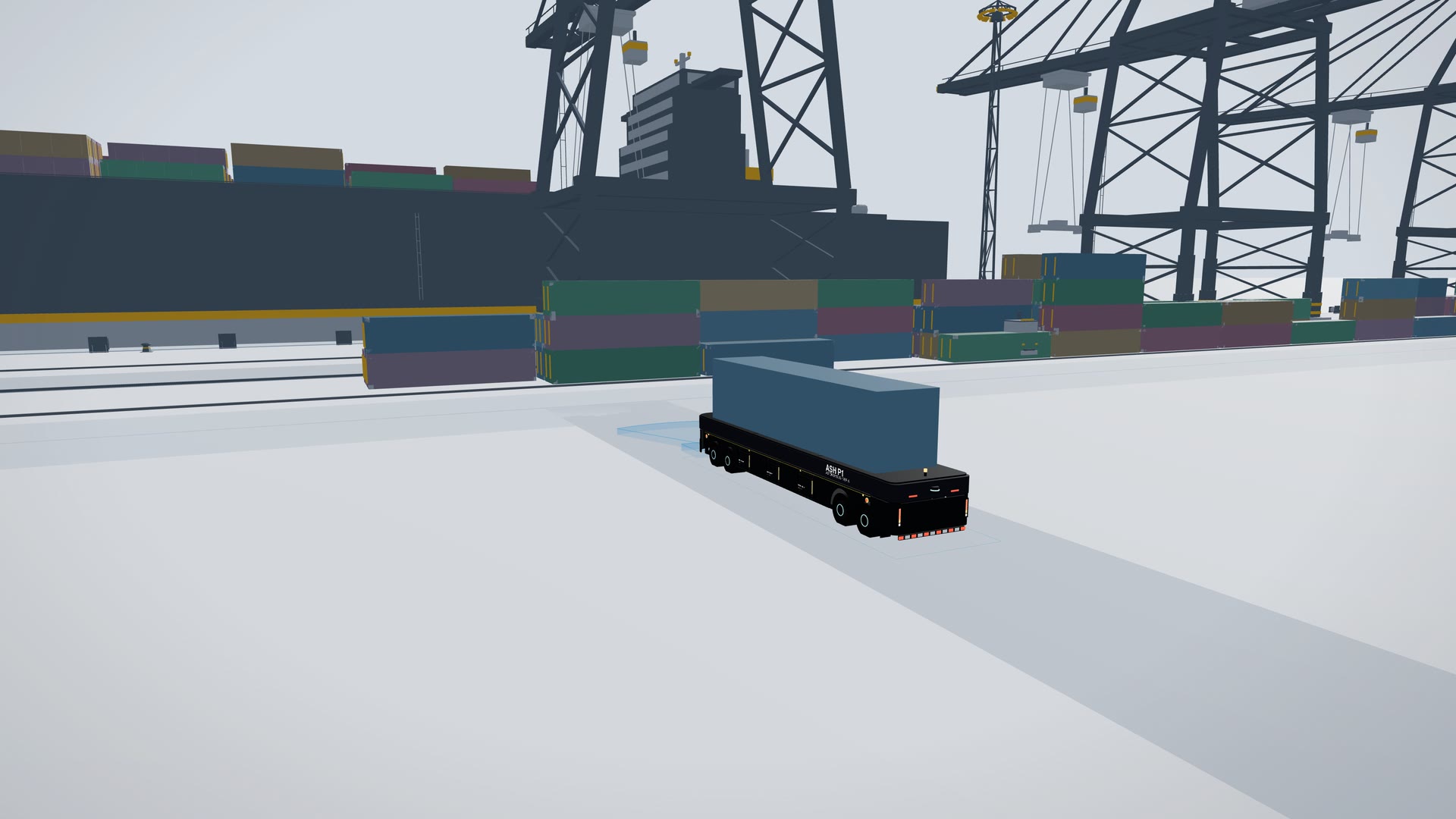
Sensing & safety envelope
LiDAR sensing with the deterministic safety envelope drawn around the vehicle: the AEB cone and stopping distance the safety core maintains from current speed and load.
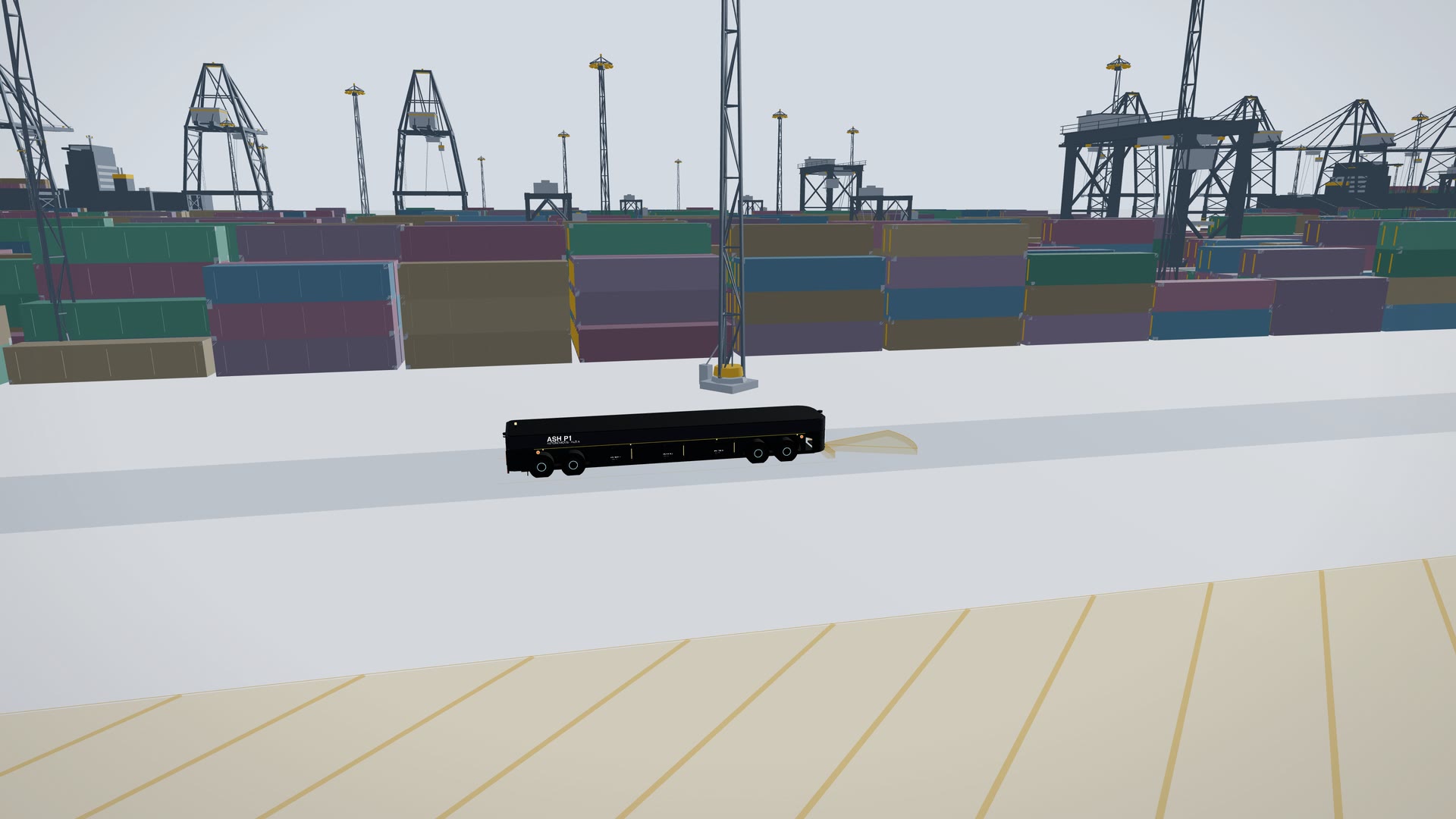
The supervisor caps a speed
At the works area the planner proposes 3.5 m/s and the Safety Supervisor approves 1.5. The two are carried as separate recorded values, with the vehicle flagged reduced margin.
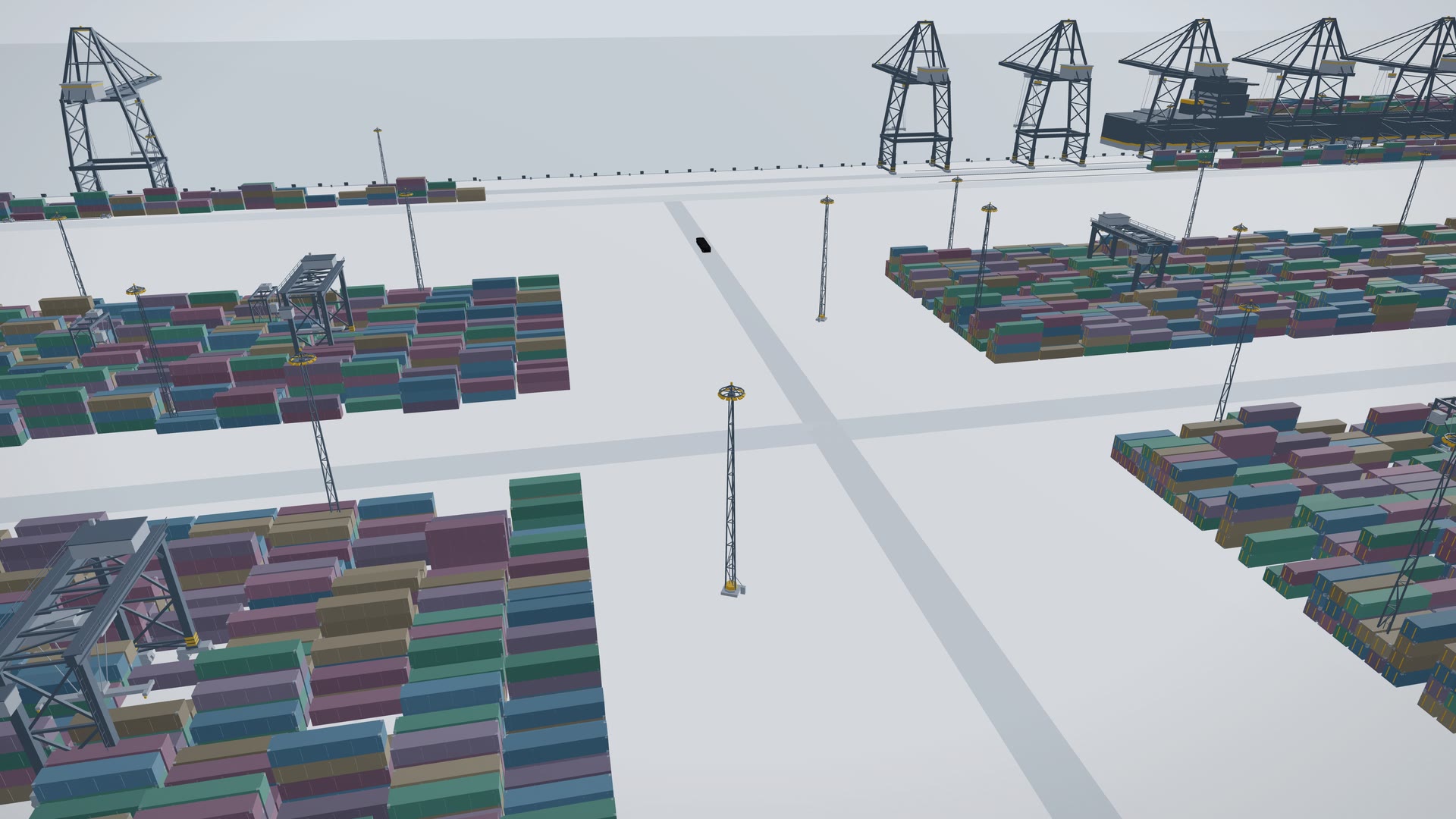
Fleet routing
Five units running concurrent independent missions across the terminal graph, each on its own planned route.
The intelligence that moves the fleet, with safety kept independent.
ASH AI is the onboard autonomy and fleet intelligence layer behind ASH P1. It combines perception, localization, motion planning and mission coordination to move heavy cargo through complex terminal environments.
While ASH AI decides how a mission should be completed, a separate deterministic safety architecture supervises vehicle speed, clearance, braking and emergency stop conditions. Operational intelligence and safety authority remain deliberately separated.
ASH AI is not a single model. It is the complete intelligence stack connecting every vehicle, mission, battery and swap station.
Early build. The production version will be more complete and more capable.
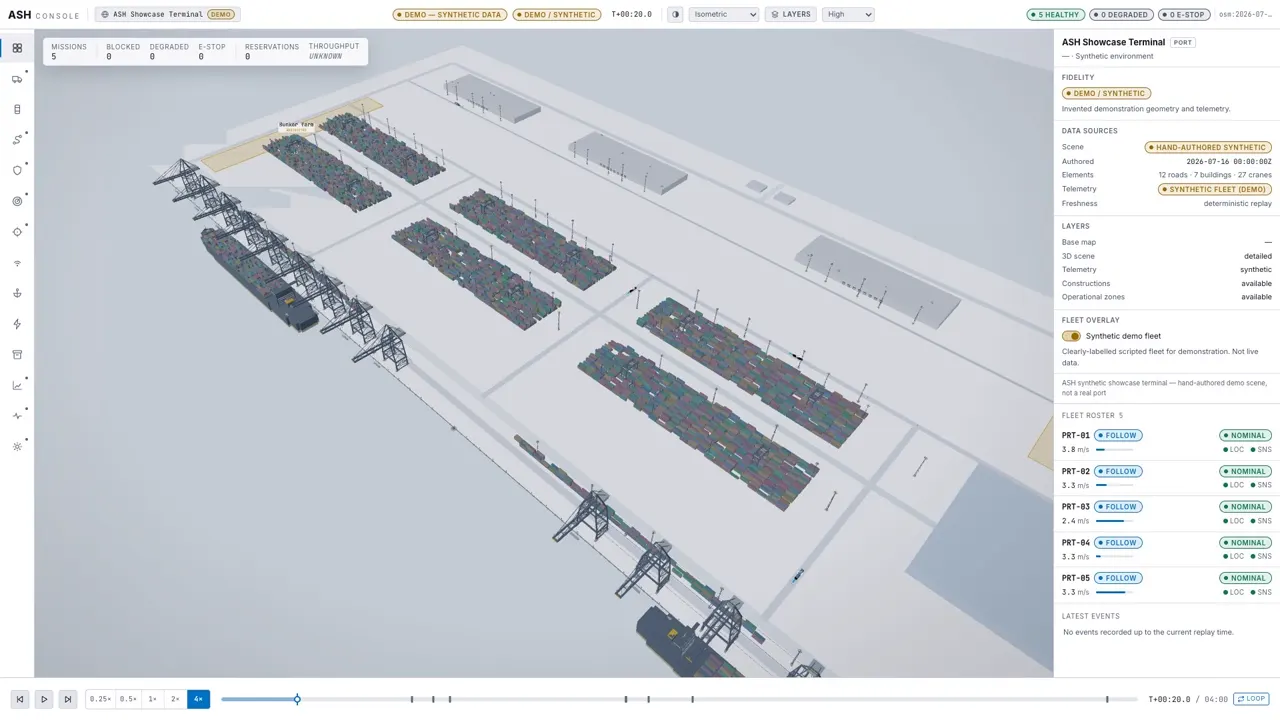
The ASH Showcase Terminal is a port we authored by hand: a 1.7 km quay, two STS crane clusters, two moored vessels, six container yard blocks with RTGs, warehouses and a connected road network. It is not a real terminal and not a customer site. It exists so the stack meets real port geometry (hard clearances, crane legs, blind corners between stacks) instead of an empty test pad. It is also a world we control, so the same run replays frame for frame and any change in behaviour is attributable.
- Vehicle
- ASH P1: tandem axles, dual tyres, swap pods, front and rear LiDAR
- Scene
- ASH Showcase Terminal: synthetic, hand authored, built to exercise this stack
- Elements
- 12 roads · 7 buildings · 27 cranes · six yard blocks with RTGs
- Telemetry
- Scripted synthetic demo fleet, clearly labelled and never live data
- Capture
- The ASH engineering console, recorded unedited and replayable frame for frame
- Not
- A customer site, a live feed, or a certified safety case
Sense, propose, approve, execute.
Four stages, four separate pieces of software, two separate authorities. Step through them.
Geometry first. Nothing inferred from pixels.
Front and rear LiDAR sweep a 25 m field with 144 rays against a 12 m safety horizon, returning range to container stacks, crane legs and whatever else stands ahead. Object identities in this simulation are ground truth read directly from scene geometry, not the output of a camera classifier, and the confidence figure the console carries alongside them is a fixed synthetic constant rather than a detector score. Nothing in this stack claims to identify people or protective equipment.
- Sensors
- Front + rear LiDAR, scan rings on the pucks
- Field
- 25 m range · 12 m safety horizon · 144 rays
- Output
- Tracked objects: range, bearing, closing rate
- Labels
- Simulated ground truth from scene geometry
An empty return is not proof of a clear road.
Driving an open yard aisle, the front LiDAR gets nothing back inside its safety horizon. The console does not call that clear. It reports AMBIGUOUS_NO_HIT, because an empty scan and a dead sensor are indistinguishable from the data alone. The same rule runs through every view: where the stack has not earned an answer, it prints UNKNOWN rather than a number.
Two authorities, one vehicle.
ASH AI proposes and executes the mission. The deterministic safety core retains final authority over vehicle motion.
What this demonstrates, and what it does not.
- A complete autonomy loop running end to end in deterministic simulation
- LiDAR based geometric sensing against real scene objects: containers, cranes, structures
- Planner proposals and safety supervisor approvals as separate, separately recorded values
- Deadman gated execution, replayable frame for frame
- Read only operator views over a clearly labelled synthetic fleet
- Camera based classification of anything, including people or protective equipment
- Operation on a real terminal, with real vehicles or real cargo
- Certification, conformity assessment or regulatory approval of any kind
- Throughput, availability or safety figures from an operating site
- Production readiness (the platform is under active hardening)
Being validated in simulation.
ASH AI is currently undergoing multi vehicle simulation testing across perception, planning, emergency stop behaviour, route execution and fleet interactions. Simulation is used to identify unsafe behaviours and edge cases before physical integration. Closed course, hardware in the loop and prototype testing follow as the vehicle development progresses.
Development status: these are engineering and simulation activities, not claims of production readiness, completed certification or deployment approval.
Engineered to be EU certifiable.
ASH does not win by out automating the frontier. It wins on a structural, physical position: a modular, upgradeable, EU certified port vehicle on a leased, open energy standard, engineered from the first board to clear the rules continental operators actually require.
When the EU Machinery Regulation takes effect in January 2027, putting AI in a vehicle's safety path triggers mandatory third party assessment. That route is slower, costlier, and no longer self certifiable. ASH's safety architecture keeps AI out of that path. It is a regulatory edge a competitor cannot copy without rebuilding their vehicle from the safety core up.
EU certification, by design
Mixed traffic autonomy that meets ISO 3691-4 and the new EU Machinery Regulation (2023/1230) is, by major OEM account, still undelivered for continental EU operators. From 20 January 2027, that regulation forces any vehicle whose AI performs a safety function into mandatory third party assessment. ASH keeps AI out of the safety path by design. It is engineered for the certification route that catches AI in safety competitors, not the slow one.
Brownfield fit
Most EU terminals are tight, operational brownfield sites in mixed traffic. Rear axle (crab) steering cuts the turning radius by 30 to 40%, so the vehicle works in existing aisles a conventional tractor cannot.
A deterministic safety core
Redundant brake by wire and steer by wire, plus a deterministic safety core independent of both the wireless link and the autonomy stack. The physical embodiment of the certification wedge.
Open, mixed fleet
Closed systems orchestrate only their own vehicles. ASH targets live brownfield terminals and orchestrates mixed fleets on an open standard: ASH, manned and third party.
A non Chinese supply chain and a non Chinese data path: fleet and operational data stays where the operator requires it, reachable by no foreign vendor. For EU and allied operators, that is not a slogan. It is a procurement requirement the dominant incumbents structurally cannot meet.
ISO 3691-4 · EU Machinery Regulation (2023/1230) · brownfield fit · open mixed fleet
These are engineering targets and a certification roadmap, not certifications already held. The moat is earned in execution.
The edge is structural, not a speed race.
Not swap versus charging. These are the axes ASH actually owns.
One vehicle, built as a modular architecture.
ASH P1 is a single vehicle, engineered as a modular architecture: the heavy chassis is a 10 year asset, while compute, sensors, energy and software are upgraded in place. You buy one vehicle and keep it current for a decade, instead of replacing a sealed robot every few years.
Intelligence Layer
Expansion Layer
Energy Layer
Base Layer
Built to be upgraded, not replaced.
Autonomy hardware improves every 18–24 months. A sealed, non upgradable AGV is obsolete before it is paid off. ASH inverts that: the heavy chassis and drivetrain are a 10+ year asset; compute, perception, energy and software are upgraded in place.
Asset life economics
A 10 year upgrade path means structurally better TCO and residual value than a throwaway robot.
Capital protected
The customer's capital is protected; the asset's useful life spans multiple technology generations.
A recurring upgrade line
Upgrading in place opens a recurring retrofit and upgrade revenue line for ASH.
The chassis is a 10+ year asset. Everything that ages fast is modular, upgraded in place and never thrown away.
One chassis · multiple technology generations · 10+ year service life
Built like heavy industry.
ASH is a vision, engineered like infrastructure. Five principles shape every design decision.
Heavy duty cycle by design
Sized and rated for the relentless duty cycle of a working port, not adapted from a lighter platform.
Modular battery interface
A single pack and swap interface specified as the platform standard, shared across swap and charge.
Safety first autonomy
Emergency stop, obstacle detection and cargo lock are first class systems, independent of the AI.
Deterministic core, AI on top
A deterministic safety stack runs the machine. AI optimizes on top of it, and never replaces it.
Port grade reliability
Designed for continuous operation in harsh terminal environments, around crews and infrastructure.
The shift to heavy electric autonomy is happening now.
Four converging shifts make the next five years the window for electric heavy cargo infrastructure.
Decarbonisation pressure is rising fast
EU measures (FuelEU Maritime, AFIR shore power, the EU ETS extension to shipping) push the whole port ecosystem to decarbonise; California targets zero emission cargo handling equipment by 2035; China's port electrification policy adds momentum. The direction is clear, even where the mandate on vehicles is still indirect.
Labor is the bottleneck
Port operators globally face a shortage of heavy vehicle drivers, sharpest in growth corridor markets where trade is expanding fastest.
Battery TCO crossed diesel
LFP cell prices fell to ~$78/kWh in 2024, with pack prices at a record ~$108/kWh in 2025 and Chinese LFP as low as ~$50/kWh. On ASH's break even model, electric heavy duty total cost is now below diesel for high utilization port duty, and still falling.
Capital is electrifying ports worldwide
Ports across every region are committing to electrification at scale, with multibillion dollar zero emission deals on the table. The first heavy cargo infrastructure provider to land them wins for a decade.
Where ASH deploys first.
ASH is built to be EU certifiable, but it deploys first where modernisation is most urgent and least resisted: labour short, capital rich, fast growing port and logistics corridors that need automation now and cannot wait years to rebuild. EU certification is the defensible moat; these growth corridors are where ASH proves itself first.
Energy lives in the swap station.
ASH P1 runs on the swap network. A depleted pack is exchanged in under three minutes and the vehicle returns to the lane. Charging happens in the station, off the critical path, never on the vehicle's schedule.
Battery Swap
Maximum uptime- Built for ports and high utilization environments
- One ~350 kWh pack, swapped as a single unit in under three minutes
- The depleted pack charges slowly in the station while the fleet keeps working
- Continuous 24/7 operation
Why swapping wins.
Swap is not what makes ASH defensible. Certification is. But swap is what keeps the certified vehicle earning: less downtime, longer battery life, and a smaller grid footprint. Three numbers, all modelled and traceable.
Energy downtime per AGV day with swap, against 4.9 hours a day on fast charge. A fast charge fleet needs about 25% more vehicles to move the same cargo. On a 20 AGV fleet that is roughly $3.5M more CAPEX.
Slow, off vehicle charging (≤0.5C) reaches about 5,500 cycles against roughly 2,000 on fast charge. That is around 2.75× the battery life, at $0.027 versus $0.075 per kWh delivered.
A flat, off peak 1.5 MW station load instead of 3–6 MW fast charge peaks. That avoids $3–8M of grid upgrade CAPEX before the first move.
Operators lease energy, not batteries.
The battery is the most expensive, fastest degrading part of the vehicle. Under Battery as a Service it sits with ASH, not on the operator's balance sheet. It is leased, not sold. Operators buy uptime and a predictable cost per move; ASH earns recurring margin on technology, never on selling battery inventory.
- The pack and its degradation risk sit with ASH, not the operator
- Operators lease energy and uptime, at a predictable cost per move
- Recurring revenue at 60%+ gross margin, with structurally low churn
<3 min swap · 2.75× battery life · 1.5 MW flat vs 3–6 MW peak · 60%+ BaaS margin
Swap vs fast charge, on your fleet.
Set your fleet and duty cycle. See swap against fast charge on the three things that decide the bill: vehicles needed, battery life, and grid peak. An illustrative model, from the same logic behind the figures above.
Illustrative model for comparison, not a quote. Assumes slow off vehicle charging for swap and on vehicle fast charging for the alternative.
A platform engineered around uptime.
Every choice in the ASH stack, heavy payload, swap network, onboard AI, exists to keep vehicles moving and energy off the critical path.
More moves per hour
Three minute swaps and AI routing keep the lane full and the berth turning. Uptime is the product.
No charging downtime
Energy lives in the swap station, not in the vehicle's schedule. The fleet keeps working while packs charge in the background.
Smarter operations
ASH AI continuously evaluates route conditions, mission demand, battery availability and fleet status to refine mission sequencing and swap timing within defined operating constraints.
Cleaner operations
Zero tailpipe emissions and quieter operations near crews, cities and coastlines. Port communities feel the difference.
Built to scale
Add vehicles, packs and stations as berth volume and corridor demand grow, with the same architecture on day one and at full scale.
Lower total cost
Fewer assets idling, lower energy cost per move and maintenance modelled into the platform from the start.
From the quay, to the dry port.
ASH P1 starts inside the terminal, the duty cycle it was designed around. Once proven and certified, the same vehicle extends along the corridor to inland dry ports, in corridor configuration, only when the route, the regulation and the demand are ready.
Port operations
Quayside container moves, yard operations and terminal logistics in mixed traffic. This is the core duty cycle ASH was designed around.
Port → dry port corridor
Longer range autonomous movement to inland dry ports using the Horizon Module and swap stations along the route. The same certified vehicle, in corridor configuration.
The product today is the vehicle.
ASH P1 is the product. It is a heavy, certifiable, electric port vehicle. The architecture is deliberately designed to extend: the same certified base can later dock the corridor module and, in time, carry other heavy cargo bodies. That is the roadmap, not the pitch. Containers first. The rest only once the first is proven, certified and earning.
From prototype to fleet.
Drivetrain & pack architecture
Heavy electric drivetrain architecture defined; modular battery pack and swap interface specified as the platform standard.
Vehicle & swap station design
ASH P1 vehicle and paired swap station: detailed engineering design; subsystem specifications, cargo grip and robotic arm handoff architecture, and the on vehicle software stack defined.
Engineering design finalized
The full ASH P1 engineering design brought to completion: drivetrain, battery and swap interface, cargo handling and the on vehicle software stack resolved into one buildable design.
Building the first prototype
The effort to build the first full ASH P1 prototype: turning the completed design into physical hardware, then into bench and rig testing.
Competitors sell a sealed truck once. ASH sells a vehicle that is never thrown away. You upgrade its autonomy, extend its reach with Horizon, and never own the part that wears: the battery. That is a structurally different product, and the category the sealed incumbents have not built.
We're building the team that builds ASH P1.
Engineering roles we open as ASH grows, across vehicle structure, manufacturing, electronics and autonomy. Brought on in sequence as the build ramps. Early enough to shape the platform, close enough to touch the hardware.
Honest answers, openly given.
ASH builds a heavy, electric, autonomous vehicle for ports. It is engineered to be EU certifiable and to run in the harshest terminal conditions, with a safety architecture that keeps AI out of the certified safety path. ASH P1 is that vehicle. Battery swap keeps it moving; the corridor module is where it goes next.
Talk to the team building ASH.
Stay close to the build.
Leave an email and the team will reach out directly with engineering updates and pilot opportunities.